Black Friday Is Here! Get 40% OFF All TCI Courses | Use Code: BLACK40 | Limited-Time Offer – Enroll Now!
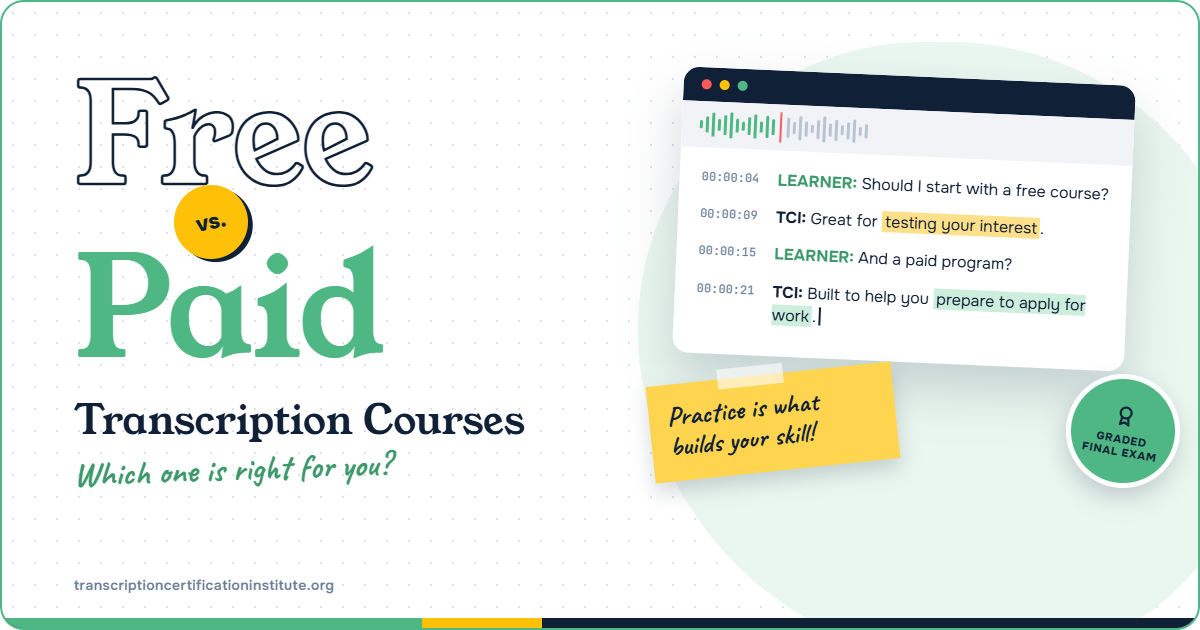



If you're thinking about transcription work, you've probably seen ads for free courses that come with a certificate. It's a smart question to ask: why pay for training when free options exist?
The honest answer is that both can be useful. A free course is a low-risk way to find out whether you enjoy the work. A paid program is built to take you further, with structured practice, feedback, and support.
This guide compares the two side by side, so you can see what you actually get, what you don't, and which choice fits where you are right now.
Free transcription courses are a good way to test the waters. Most include some or all of the following:
✓ An introduction to transcription: what the work is, the main types, and the basic tools
✓ Short lessons on core rules: verbatim styles, punctuation, and common formatting
✓ A few practice files: often short, clear recordings with one or two speakers
✓ A completion certificate: proof that you finished the course
That's real value when you're still deciding. You can learn whether you like careful listening and typing before you spend money on anything.
The limits of a free course usually show up once you try to apply for work. Here's what's often missing:
✓ Feedback on your work. You may type a practice file, but no one checks it and tells you what to fix. Without feedback, it's hard to know if your accuracy is where companies expect.
✓ Difficult audio. Real files have accents, background noise, crosstalk, and several speakers. Free practice files tend to be short and clean.
✓ Depth on style guides. Companies test you on tags, speaker labels, and timestamps. Free courses often touch these only briefly.
✓ A final exam with standards. A completion certificate shows you finished. A certificate tied to a graded exam shows you met a standard.
✓ Support and next steps. Free courses rarely include a community, job resources, or someone to answer your questions.
None of this makes free courses bad. It just means they're a starting point, not a full path. If you want to sharpen one skill first, our guide on how to follow a transcription style guide is a good place to begin.
A good paid program is built around one goal: helping you work accurately and confidently on real files. That usually means:
✓ A full lesson path: from the basics through verbatim styles, editing, research, and time stamps, in a set order
✓ Varied practice audio: files with different speakers, accents, and sound quality
✓ Quizzes and a graded final exam: so you know where you stand before you apply anywhere
✓ Study materials: a study guide or reference you can keep using on the job
✓ Real-world experience: some programs offer internship opportunities or hands-on projects
✓ Community and career resources: a forum, job board, or guidance on tests and resumes
| What you're comparing | Typical free course | Typical paid program |
|---|---|---|
| Cost | $0 | A one-time fee, often with payment options |
| Lesson depth | Introductory | Full path from basics to job-ready skills |
| Practice audio | A few short, clear files | Varied files, including harder audio |
| Feedback | Rare | Quizzes, graded exams, and reviewed work |
| Style guide training | Brief | Detailed, with examples |
| Certificate | Proof of completion | Earned by passing a final exam |
| Hands-on experience | Rare | Often included, such as internship opportunities |
| Support | Self-guided | Community, resources, and help when you're stuck |
| Best for | Testing your interest | Preparing to apply for transcription work |
Use your goal to decide:
✓ Start with a free course if you're still curious, you've never tried transcribing, and you want a no-cost way to find out if you enjoy it.
✓ Choose a paid program if you already know you want transcription work and you'd like structured training, feedback, and a certificate that reflects a tested standard.
✓ Do both if you want a quick taste first. Many learners try free material for a week or two, then move into a full program once they're sure.
Whichever you pick, practice is what builds your skill. A routine of daily listening and typing will help you get more out of any course.
Not sure transcription is right for you yet? Take our quick career quiz to find out. Bonus: get a $50 OFF coupon if transcription is a good fit for you.
Whether a course is free or paid, these questions help you judge its quality:
1. What exactly will I learn? Look for a clear lesson list that goes beyond the basics.
2. Will I practice on realistic audio? Look for files with more than one speaker and some background noise.
3. How is my work checked? Quizzes and a graded final exam tell you more than a completion badge.
4. Who recognizes the certificate? Ask whether the school has industry approvals or partnerships.
5. What support is included? A forum, study guide, or job resources make a big difference after the lessons end.
6. What is the refund policy? A clear policy shows the school stands behind its training.
TCI's General Transcription Certification course is a 3-week, 100% online program designed to help you work accurately from your first file. It includes:
✓ Lessons on verbatim and non-verbatim styles, editing, research, word expanders, and time stamps
✓ A study guide that prepares you for every quiz and the final exam
✓ Free tools such as practice tests and e-books, plus a discussion forum and a job board
✓ Internship opportunities for U.S. residents to gain hands-on experience
TCI is also an AAERT Approved School, so the training you start here can grow with you if you later move into legal or court transcription.
Check the current course fee, payment options, and refund terms on the TCI FAQ page before you enroll.
Many are. A free course can teach you the basics and help you decide if transcription suits you. Just check what it includes, since most free courses offer limited practice and little feedback.
Most transcription companies hire based on their own skills test, not a certificate alone. A certificate can help your application, but your test results matter most. Training that prepares you for those tests is what makes the difference.
It can be, if you want structured lessons, varied practice, and feedback before you apply for work. Compare what each program includes, review the lesson list, and check the refund policy before you decide.
Yes. Many learners start with free material to test their interest, then enroll in a full program once they know transcription is a good fit.
The best first step is knowing whether this work suits you. Take TCI's career quiz to find out, and get a $50 OFF coupon if transcription is a good fit for you.
Ready to go further? Explore TCI's General Transcription course and see every lesson in the program.
Take the Career Quiz Explore the General Transcription Course

Can be better
Easy to read/ understand
Found it helpful



Your TRANSCRIPTION CAREER CAPSULE to Help You BOOST Your Potential
Latest Industry News, Jobs, Tips and More..


Be the first to post a comment