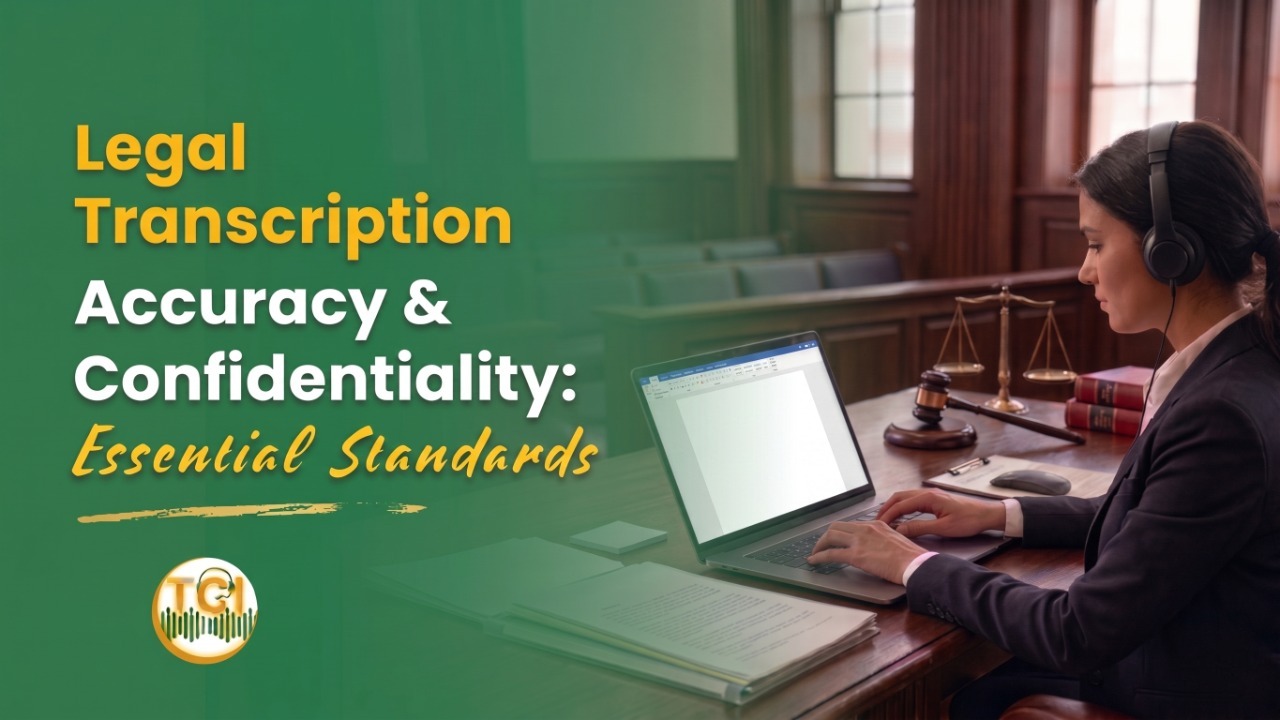
Every word spoken in a courtroom deposition, a criminal hearing, or a contract negotiation carries legal weight. When those words are transcribed inaccurately - or when the record falls into the wrong hands - the consequences can be devastating: wrongful convictions, dismissed cases, violated privileges, and ruined careers. Legal transcription sits at the intersection of language, law, and ethics, and the professionals who do it right are indispensable to the justice system.
This guide unpacks the essential standards of accuracy and confidentiality that every legal transcriptionist must uphold - whether you are just entering the field or looking to sharpen your professional edge.
1. Why Accuracy Matters in Legal Transcription
In everyday transcription, a small error might cause mild confusion. In legal transcription, a single misheard word can alter the meaning of a testimony, misrepresent a client's statement, or invalidate evidence. The legal record is not a summary - it is a verbatim, permanent account of what was said, by whom, and in what context.
Consider a deposition where a witness says, "I did not strike the defendant." If a transcriptionist mishears or mistypes this as "I did strike the defendant," the consequences could be catastrophic. Courts rely on the transcript as the authoritative record — not the recording. Once entered into the official record, errors are extraordinarily difficult to correct.
"In the legal world, the transcript is the truth. Everything else is secondary to what appears on that page."
Legal transcription also plays a central role outside the courtroom: in law firm documentation, police interviews, administrative hearings, immigration proceedings, arbitrations, and attorney-client meetings. Each context demands the same uncompromising commitment to accuracy.
2. The Accuracy Standards Every Legal Transcriptionist Must Know
Verbatim vs. Clean Verbatim Transcription
Most legal transcription demands true verbatim output - meaning the transcript includes every word, filler word, false start, stutter, and interruption exactly as spoken. In some non-court legal settings, "clean verbatim" (where minor fillers like "um" and "uh" are removed) may be acceptable. Understanding which standard applies to each assignment is a critical professional skill.
Important Distinction
Court reporter transcripts are always strictly verbatim. Never apply clean verbatim standards to court proceedings, depositions, or official legal hearings unless explicitly authorized in writing by the supervising attorney or court officer.
Mastery of Legal Terminology
Legal language is a specialized dialect. Without a working knowledge of Latin phrases, procedural terms, case citation formats, and jurisdiction-specific vocabulary, a transcriptionist will struggle to produce accurate work. Common areas of required knowledge include:
Civil and criminal procedure terminology (habeas corpus, voir dire, mens rea, subpoena duces tecum)
Court hierarchy and title protocols (Your Honor, Counsel, Petitioner, Respondent)
Medical-legal terms that arise in personal injury or workers' compensation cases
Financial and contract law terminology in commercial depositions
Proper formatting of citations, case numbers, exhibit references, and docket entries
Speaker Identification and Dialogue Formatting
Legal transcripts must clearly identify every speaker at all times. Correct attribution of dialogue is as important as the words themselves. When multiple attorneys, a judge, witnesses, and the court reporter are all speaking, the transcriptionist must maintain clear, consistent formatting - using proper headers, Q&A format for examinations, and parenthetical notations for non-verbal events (e.g., [witness pauses], [objection sustained]).
Proofreading and Quality Control
Accuracy is not achieved in a single pass. Professional legal transcriptionists read back against the original audio at least once, often multiple times, and use specialized playback tools that allow them to slow down audio without distortion. Every proper noun, name, address, date, and legal citation should be independently verified for spelling and accuracy.
3. Common Errors That Compromise Legal Transcripts
Understanding what can go wrong is the first step toward preventing it. The most frequent accuracy failures in legal transcription include:
1.Mishearing homophones: Words like "tortious" vs. "tortuous," or "statute" vs. "statute of limitations" can easily be confused in fast-paced legal dialogue.
2.Incorrect speaker attribution: Assigning a line of testimony to the wrong party can distort the factual record irreparably.
3.Omitting inaudible notations: When audio quality is poor, transcriptionists must flag inaudible portions with [INAUDIBLE] rather than guessing. Guessing is never acceptable in legal work.
4.Improper punctuation: Punctuation changes meaning. "The defendant, who had no prior record, was sentenced" carries a different legal implication than "The defendant who had no prior record was sentenced."
5.Formatting inconsistencies: Changing exhibit reference formats, inconsistent capitalization of titles, or varying date formats within a single document raise questions about the document's reliability.
6.Failure to note non-verbal cues: When a witness nods, laughs, or breaks down, this must be noted. Legal transcripts capture communication, not just words.
4. Confidentiality: The Non-Negotiable Obligation
Accuracy earns trust in the transcript itself. Confidentiality protects the people behind it. Legal transcriptionists handle some of the most sensitive information that exists: criminal allegations, medical records introduced as evidence, private business communications, immigration status, family law disputes, and trade secrets. The obligation to protect this information is not a courtesy - it is a legal and ethical imperative.
Every document that passes through a legal transcriptionist's hands belongs to the attorney, client, or court that commissioned it. The transcriptionist has no right to share, discuss, retain, or otherwise use that information beyond the scope of the assignment. This applies even when:
The case involves a public figure or a high-profile criminal matter
A colleague or family member asks an innocent-seeming question about your work
The work has been completed and invoiced
The transcriptionist personally believes the information is publicly available
No formal confidentiality agreement was signed (the ethical obligation exists regardless)
"Confidentiality in legal transcription is not a policy you follow when it is convenient. It is a professional identity you inhabit at all times."
5. Legal and Ethical Framework Governing Confidentiality
Attorney-Client Privilege
The most foundational protection in the legal system, attorney-client privilege shields communications between a lawyer and their client from disclosure. Legal transcriptionists who work on privileged communications are considered agents of the attorney and therefore bound by the same privilege. Disclosing even the existence of such work to an unauthorized party can constitute a waiver - with serious legal ramifications.
Work Product Doctrine
Materials prepared by or for attorneys in anticipation of litigation are protected as "work product." Transcriptions of attorney strategy sessions, internal communications, or interview notes are often covered under this doctrine. Transcriptionists must understand that these materials cannot be shared, even after a case concludes.
Court Sealing Orders and Protective Orders
Courts frequently issue orders sealing specific evidence or restricting who may access certain records. A legal transcriptionist working on sealed materials has an absolute obligation to comply with those orders - including destroying or securely returning materials when directed by the court.
State and Federal Privacy Laws
Legal transcriptionists must also navigate privacy statutes, including HIPAA when medical records are introduced in litigation, state-level privacy protections, and regulations governing juvenile proceedings, immigration cases, and domestic violence matters. Working in legal transcription without awareness of these frameworks is not simply unprofessional - it is legally dangerous.
Professional Best Practice
Always ask your client whether any special privacy laws, sealing orders, or protective orders apply to a project before beginning work. Document their response in writing. This protects both parties and ensures you have the correct handling instructions before you start.
6. Best Practices for Maintaining Confidentiality
Secure File Handling and Storage
All audio files, draft transcripts, final documents, and any notes must be stored in encrypted, password-protected environments. Cloud storage for legal work must meet industry-grade security standards - consumer-level personal accounts are not appropriate for privileged legal documents. Use encrypted storage solutions and ensure backups are equally secured.
Non-Disclosure Agreements
While ethical obligations exist independently, always request or agree to a formal non-disclosure agreement (NDA) for legal transcription work. An NDA formalizes the relationship, clarifies expectations, and provides legal recourse if a breach occurs. Reputable law firms and legal outsourcing companies will routinely require these.
Device Security
The computer used for legal transcription should be dedicated to work use, have full-disk encryption enabled, strong unique passwords, and be protected by up-to-date antivirus and firewall software. Avoid working on legal files in public spaces. Headphones should always be used - never speakers - when transcribing confidential audio in any shared environment.
Secure Transmission
Delivering completed transcripts requires the same care as storing them. Use end-to-end encrypted email or secure file transfer platforms. Never transmit legal documents via unencrypted personal email or messaging apps. Confirm receipt with the client and, where required, follow a chain-of-custody protocol for the files.
Proper Document Destruction
Once a project is complete and files are no longer needed, all copies must be destroyed using appropriate methods: secure file deletion (not just emptying the recycle bin), overwrite software for digital files, and physical shredding for any printed drafts.
Use a reputable file shredder application for digital deletion, not standard delete commands
Maintain a written log of when and how materials were destroyed for each assignment
Remove all backup copies, including any auto-save files in word processing software
Return original audio files to the client when specified in the agreement
7. Technology's Role in Accuracy and Security
Transcription Software and Tools
Modern legal transcriptionists use specialized software designed for the demands of legal work: adjustable playback speeds, foot pedals for hands-free control, time-stamping features, and built-in legal glossaries. Tools like Express Scribe, InqScribe, and legal-specific word processors with macro libraries for common Latin phrases significantly improve both efficiency and accuracy.
AI Transcription: Opportunity and Caution
Artificial intelligence transcription tools have become powerful and fast, but they remain unsuitable as standalone solutions for legal work. AI tools frequently struggle with overlapping speakers, heavy accents, domain-specific terminology, and the nuanced formatting requirements of legal documents. More importantly, submitting confidential legal audio to cloud-based AI services raises serious privacy concerns - many platforms retain audio data on their servers.
Also Read :- Why Legal Terminology for Transcription and Court Reporting Still Matters in the AI Era
AI and Legal Confidentiality
Before using any AI-assisted transcription tool on legal audio, verify the platform's data retention and privacy policies carefully. Many services use submitted data to train their models. Uploading privileged client audio to such a platform could constitute a breach of confidentiality and potentially a waiver of attorney-client privilege.
The professional standard is clear: AI may assist, but a qualified human legal transcriptionist reviews, edits, formats, and certifies every document before delivery. The responsibility - and the accountability - always rests with the professional.
Version Control and Audit Trails
Maintaining clear version control for draft and final transcripts is a professional discipline that protects both the transcriptionist and the client. Use file naming conventions that include date and version number, and keep an audit trail of revisions. In litigation, it may one day matter exactly what the transcript said at each stage of its production.
8. Building a Career on These Standards
The legal transcription professionals who build lasting, respected careers are those who make accuracy and confidentiality non-negotiable from the very beginning. These are not values that can be adopted situationally — they are the bedrock of professional credibility in a field where credibility is everything.
Clients in the legal industry rely on referrals, reputation, and trust. A single confidentiality breach or repeated accuracy issues will end a legal transcription career faster than any economic downturn. Conversely, transcriptionists who consistently deliver impeccable, secure work become indispensable to the law firms, courts, and legal outsourcers they serve.
Continuing Education and Certification
The law evolves, technology evolves, and the standards of the profession evolve with them. Staying current through professional development - including recognized training programs and certification courses - signals to clients that you take the work seriously. It also equips you to handle emerging challenges: new privacy regulations, evolving AI tools, and expanding practice areas that create new transcription demands.
Professional Associations
Organizations such as the American Association of Electronic Reporters and Transcribers (AAERT) provide community, continuing education, certification pathways, and professional standards that elevate the entire field. Active involvement in the professional community keeps you connected to best practices and demonstrates commitment to the craft.
"Your reputation as a legal transcriptionist is built one accurate, confidential transcript at a time. There are no shortcuts — and no second chances after a breach of trust."
What Clients Actually Look For
When law firms, litigation support companies, and courts evaluate legal transcriptionists, they assess a specific combination of qualities:
Demonstrable accuracy - typically tested with sample transcription assignments
Familiarity with legal terminology and document formatting conventions
Clear understanding of confidentiality obligations and willingness to sign NDAs
Documented training from a recognized and reputable program
Reliable turnaround times and professional communication
References from prior legal clients or supervisors
Formal training is often the fastest way to establish credibility with these clients, particularly for those entering the field. A recognized legal transcription certification demonstrates that you have been taught the industry's standards - not just that you can type quickly.
Final Thoughts
Legal transcription is a profession built on two pillars: the precision of what you capture and the integrity of how you protect it. Every professional in this field is, in a very real sense, a guardian of the legal record - and by extension, of the rights and interests of the people whose words that record contains.
The standards explored in this article are not aspirational targets. They are the baseline expectations of every client, every court, and every professional association in the legal transcription industry. Meeting them requires knowledge, training, discipline, and a genuine respect for the weight of the work.
Whether you are considering a career in legal transcription or looking to formalize the skills you already have, the path forward starts with the right foundation. The good news? That foundation is entirely learnable - and it begins here.













Be the first to post a comment