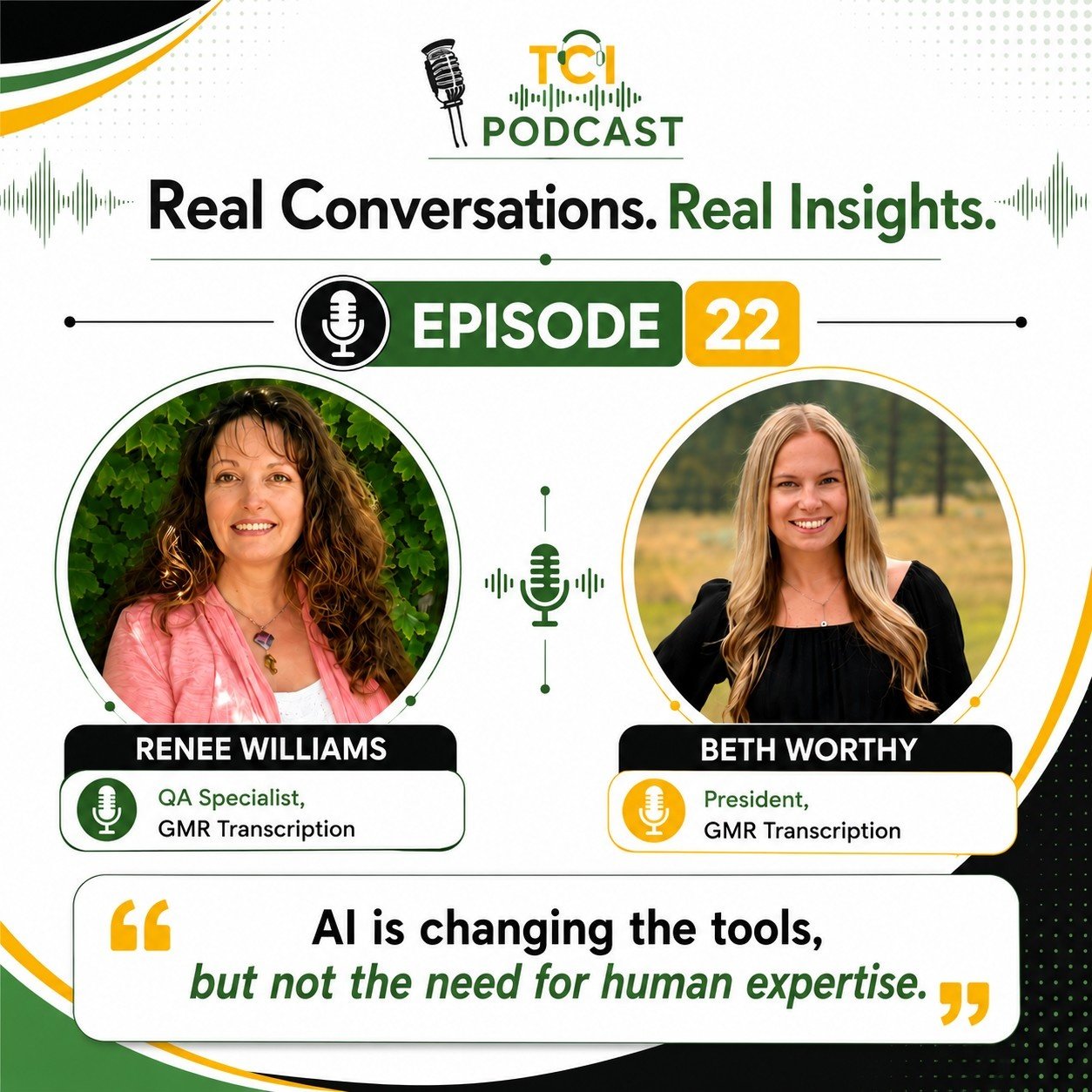
Beth Worthy is the Cofounder & President of GMR Transcription, leading the company with a focus on quality, innovation, and the integration of AI with human expertise. Renee Williams is the QA Specialist at GMR Transcription, where she mentors transcriptionists and ensures high-quality transcription standards. Together, they share expert insights on AI, transcription careers, and the future of the industry.
Minnie Sinha: Hi everyone. This is Minnie with the latest episode of our podcast uSpeak. Today I am especially excited because we are welcoming back a very familiar guest. Beth Worthy, president of GMR Transcription, was actually the very first guest on the uSpeak podcast, so it is a full circle moment. When we first spoke we talked about what makes transcription such a rewarding career, the qualities GMR looks for when hiring, and why strong training and professionalism are so important. A lot has happened since then. The transcription industry has experienced tremendous change, especially with the rapid advancement of AI.
But one thing has not changed, GMR’s commitment to quality and the importance of skilled human transcriptionists. Today we are catching up with Beth to learn how the industry has evolved, what employers are looking for today, and what the future holds for transcriptions professionals. Joining Beth today is Renee Williams who works closely with the GMR Transcription team. She will be sharing her firsthand perspective on what it takes to produce high quality transcripts and how transcriptionists are adapting in today’s changing landscape. Beth, Renee, welcome to uSpeak. It is wonderful to have you both here.
Beth Worthy: Thank you so much for having me back. I am super excited to have Renee joining me this time.
Renee Williams: Yes, thank you for having me.
Minnie Sinha: You are most welcome. You two are most welcome. So, let us start this. Since my last interview with you Beth, how has the transcription industry changed?
Beth Worthy: I think you kind of hit the nail on the head when you mentioned AI because that has definitely been the biggest change since last time we talked. I think many people thought that AI would make human transcription basically disappear. But we have seen a little bit different where it is more of a split market where some customers want that instant, inexpensive draft. So, AI would definitely make sense for those. Maybe it is writers dictating notes for their next book or a student recording a lecture. It does not necessarily have to be a perfect transcript.
Then there are still so many clients who simply cannot afford mistakes. Whether it is research, financial, legal, or simply someone who just has a transcript where every word matters, they need transcripts that they can trust. So, we often see clients also needing specialized formatting, tailored service, or they just want to work with real people. That is I think where GMR still shines. That is where we plan to stay.
Minnie Sinha: So, that market is still alive, right? You still have people looking for such services?
Beth Worthy: Yes, exactly, definitely. We have seen that many organizations are just realizing that accuracy, confidentiality, and accountability still matter. So, one thing though is that we have learned to embrace AI but in a way that still supports our clients and does not replace our transcriptionists. Just I think only like three weeks ago we launched our AI enhancement tools for our clients where all of our transcripts are still produced by professional human transcriptionists. After the transcript is completed, the clients can now use some pretty cool AI enhancement tools.
One of which is our AI summary, which is basically they get a quick review of key takeaways from their transcript. Which is super helpful if they have a two-hour audio that they got transcribed, just getting a summary of that can be very helpful. The other one, which is kind of even cooler, is our AI analysis tool. That is where you can put your transcript in it. You can ask the AI questions, get identifying themes, extract insights, and basically interact with the transcript. AI is working from an accurate human transcript instead of trying to create one from scratch. I just believe that is where AI provides the most value.
Minnie Sinha: Okay. That sounds great. Renee, what is your take on this?
Renee Williams: My take is the way the transcription industry has changed is that human transcription and problem solving remain unmatched. Human transcriptionists still solve problems that AI struggles with like multiple speakers, heavy accents, industry terminology, poor audio, understanding context of the transcript and the audio, overlapping conversations like crosstalk, and organic speech patterns. Speech-to-text software and EMR have been around for probably 25, 30 years. There is still a huge need for human transcription.
Minnie Sinha: Great. Let us go to the next question. How have the skills required of transcriptionists evolved?
Beth Worthy: I think today it is much more about critical thinking, as Renee just mentioned, definitely research is involved, having language skills, attention to detail, and confidentiality is so huge. So, yes, the AI can generate words, but most clients need a product that is much more involved to produce a quality transcript.
Minnie Sinha: Renee?
Renee Williams: I think it is not just about transcribing what we hear anymore. Transcriptionists are needing to interpret meaning and context. AI cannot necessarily discern when things do not make sense in the audio or in a transcript. Researching terminology has become much more important to transcriptionists, identifying speakers like we talked about, and making judgment calls. Sometimes you have to make a decision on what you think you are hearing or what makes the most sense. Discerning difficult and fast paced speech, people are in more of a hurry when they are dictating and speech gets slurred, it gets in a hurry. So, that is a human skill that transcriptionists are always going to need to have.
Discerning speech patterns, human ears can make out and understand repeated speech patterns. Those are all skills that AI still struggles with.
Minnie Sinha: Actually, can you share a situation where a transcriptionist’s research skills made a bigger difference than simply being able to type quickly?
Beth Worthy: First, touching on the typing quickly, accuracy is always going to trump speed when it comes to transcription. We actually generally do not care how long a transcription takes for a typist to produce. We care how true and correct the transcript is to the audio. In almost every transcription, a huge part of that is getting uncommon words spelled correctly. That is where some research techniques are going to come in. It is not always just a simple Google search. Sometimes you kind of have to know where to look.
One example is that if you are transcribing an audio and say the speaker mentions a professor at MIT and you could not quite get the last name, a good transcriptionist is going to probably go to the MIT website, look for the page for the department that is being discussed, and then search the directory for that specific professor to get the spelling of the last name correct. Just really going the extra mile for accuracy is what a good transcriptionist would do in that situation.
Minnie Sinha: Great point. Also, since we are living in an AI world, is foundational transcription training more important today?
Beth Worthy: I would say absolutely. Ironically, I think AI has made training even more important just because anyone can generate an AI transcript, but not everyone can recognize its mistakes and correct it to make an accurate transcript. I think that proper training is going to teach you grammar, specialized formatting, how to research, what quality standards are, and definitely confidentiality practices. I think that those fundamentals have become even more valuable with the influx of AI generated content.
Minnie Sinha: Okay. Renee, do you want to add to that?
Renee Williams: Sure. I think strong fundamentals make people much easier to train. When they come to us with strong skills, that is half the battle for me when training people. Transcriptionists that have foundational training understand our rules and processes better when they come to us. Training helps transcriptionists understand our company’s specific guidelines and quality standards better. Our company has really high-quality standards. It surprises people sometimes who want to onboard with us how meticulous we are with our quality standards, consistency, and strict grammar protocols.
Minnie Sinha: Moving on to the next question. As you may know, we have been working with GMR Transcription. You have been generous in offering internships to our students. What has been your experience working with interns as they develop into professional transcriptionists? Beth, can you [inaudible – crosstalk] [00:10:21]
Beth Worthy: I just cannot say enough about our partnership with TCI. We have loved getting interns from you guys. Students, they seem to come with a stronger foundational knowledge of transcriptions. I did not know if you know this, but when we are hiring, we actually do not require any experience. We do have a very strict vetting process. New typists do have to go through tests. We are only hiring the best. With that being said, many of them have never done transcription before but they just have a good knack for it, so they get hired with us.
There is just a really big difference that we have seen with the people who are just starting fresh and the people who have kind of an already understanding of transcription to begin with. The internship teaches them things like how it is to work with a real client, like meeting deadlines, client expectations. Then communication is a big one. Renee definitely works more closely with our TCI interns. I have seen from my standpoint that it is pretty cool to watch them grow into the profession.
Minnie Sinha: Okay. Renee?
Beth Worthy: So, I love working with new transcriptionists and mentoring them and helping them along. It is super exciting to see their confidence grow with each project and provided guidance. It is exceptionally helpful when they come to GMR already with a strong skillset in place. Some of our strongest transcriptionists started exactly this way.
Minnie Sinha: I think many of our interns, I believe they that they are good that they would get hired by GMR Transcription, if I am not wrong. Correct?
Renee Williams: I am sorry, can you say again?
Minnie Sinha: I am saying that many of our interns who do internships with you, GMR, they do in the end they end up hiring with you guys right?
Renee Williams: Yes. It is a long process, but it does help them to grow. Usually we end up hiring them or they end up getting hired somewhere, yes.
Minnie Sinha: Okay. So, tell me what is the biggest transformation you see from an intern’s first week to the end of their internship?
Renee Williams: That is a thoughtful question. I think it is confidence because when an intern comes to us they are usually nervous. To be fair, there is a lot to learn at our company and a lot to take in. We have really high standards, like I said. They are usually nervous and second guessing themselves and everything. Once they do a few transcripts and they understand everything and learn the ropes and they learn that I am not the big, bad guy, then it is fun to watch how they develop their own style and things flow so much easier. Once they get their feet under them, so to speak, there is no stopping them. I love that.
Minnie Sinha: Great. So, moving on to the next one. After reviewing our website and curriculum, is there anything you would recommend adding to better prepare our students for today’s transcription industry and improve their employability?
Beth Worthy: I think just from seeing our experience with the interns that we have gotten from TCI, I think you guys are doing a great job preparing students. If I had to think of some potential additions, I think I would say maybe reviewing AI generated transcripts, since that is just becoming more and more popular. Definitely research techniques, handling confidential information, and then maybe something about how important client communication is, how to work with different clients in a professional manner. I would say confidentiality is probably going to be the most important, though. It seems like our clients are increasingly needing confidentiality and understanding data security.
Minnie Sinha: Okay. Those are great points. We will definitely take a look at that and try to add that if we are missing those points. Renee, do you have anything to say there?
Renee Williams: I also agree with Beth. I think your curriculum is great and I think you guys are doing a great job preparing transcriptionists. A few things that come to mind are the ability to recognize AI mistakes. That is going to be an increasingly valuable skill going forward in today’s market. Just the different types of formatting and templates might be – I cannot remember what the lesson is there, but might need to touch on that, the different types of formats and templates. Because formatting is important for human transcription because that is something that AI cannot really do very well.
Understanding that every company has their own style requirements. It is not just one shoe fits all. Also, that human transcription still remains very valuable. When transcriptionists can harness their abilities and implement the concepts of human transcription and their strong skillsets in that, whatever those are, and they can hone in on that, that will make them uniquely qualified to some employers.
Minnie Sinha: Okay. Great point. If you could give one piece of advice to every new transcription student before they start working professionally what would it be?
Renee Williams: I think it is just to be flexible because the industry continuously changes. Like I was saying, whatever is your gift, whatever is your strong point, your strong suit, focus on that and utilize that to be the best at what you do and earn a great living and be confident in yourself.
Minnie Sinha: Okay. What are the two top qualities you look for today when hiring?
Beth Worthy: I think just from seeing our experience with the interns that we have gotten from TCI, I think you guys are doing a great job preparing students. If I had to think of some potential additions, I think I would say maybe reviewing AI generated transcripts, since that is just becoming more and more popular. Definitely research techniques, handling confidential information, and then maybe something about how important client communication is, how to work with different clients in a professional manner. I would say confidentiality is probably going to be the most important, though. It seems like our clients are increasingly needing confidentiality and understanding data security.
Minnie Sinha: Okay. Those are great points. We will definitely take a look at that and try to add that if we are missing those points. Renee, do you have anything to say there?
Renee Williams: I also agree with Beth. I think your curriculum is great and I think you guys are doing a great job preparing transcriptionists. A few things that come to mind are the ability to recognize AI mistakes. That is going to be an increasingly valuable skill going forward in today’s market. Just the different types of formatting and templates might be – I cannot remember what the lesson is there, but might need to touch on that, the different types of formats and templates. Because formatting is important for human transcription because that is something that AI cannot really do very well.
Understanding that every company has their own style requirements. It is not just one shoe fits all. Also, that human transcription still remains very valuable. When transcriptionists can harness their abilities and implement the concepts of human transcription and their strong skillsets in that, whatever those are, and they can hone in on that, that will make them uniquely qualified to some employers.
Minnie Sinha: Okay. Great point. If you could give one piece of advice to every new transcription student before they start working professionally what would it be?
Renee Williams: I think it is just to be flexible because the industry continuously changes. Like I was saying, whatever is your gift, whatever is your strong point, your strong suit, focus on that and utilize that to be the best at what you do and earn a great living and be confident in yourself.
Minnie Sinha: Okay. What are the two top qualities you look for today when hiring?
Renee Williams: It is hard to narrow it down to two. If I narrowed it down to two, I would say accuracy, that is the one that matters the most of course, attention to detail, the ability to produce a high quality and accurate transcript. Also, reliability because communication is so important. It is so important for employers to have somebody they can trust to get the job done. But if there was a third one, I would still say speed because speed matters most when you are a transcriptionist and you are trying to make a living.
Minnie Sinha: Right. Beth?
Beth Worthy: So, I would say Renee’s top two would be my top two. So, she stole those. But I would say probably maybe curiosity. I think the best transcriptionists are going to be curious enough to research unfamiliar words, maybe be more willing to try new things, whether that is getting into more difficult audios or trying new formatting jobs. Just having a curiosity to try new things I think is always going to be a plus. Then positivity I would say. Someone who is just nice to work with goes so long – goes a long way in my book. That is just something that if you are positive it just makes such a huge difference.
Minnie Sinha: Do you think these core qualities can be taught? Or do you think people naturally possess them?
Renee Williams: For me, I have been in the business for a really long time, many, many years. What I have seen is I personally think that people naturally possess these qualities or they do not. You are either made for this work, or you are not. That is my opinion from my experience. Other people might have a different opinion. I have seen many people struggle and struggle. This industry is just not the right fit for them. That is okay. On the other hand, some people are naturally inclined for this work. They can have fun and make a great living at it.
Minnie Sinha: That is very true. Moving on to the next question, what is the biggest misconception people have about AI and transcription?
Beth Worthy: I think 100% the biggest misconception is that AI is replacing every transcriptionist. I think that is totally false. I think AI is actually really creating more opportunities for the highly skilled transcriptionists. I have seen firsthand that AI is not the right solution for every project. In fact, many of our clients have tested AI transcription and they end up making their way back to GMR. That just kind of tells me that there is always going to be organizations that are going to need a human touch. Whether it is, like we talked about, complicated formatting, strict data requirements, simply just having an accurate transcript and real humans to work with, I think is not going to go away.
Minnie Sinha: Renee, do you want to say something about this?
Renee Williams: Sure. I think one of the biggest misconceptions about AI is that people think it is accurate or it is good enough, it produces a good enough transcript. I have just seen time and time again that there are many instances where it is not good enough and it is not accurate. There is often incorrect speaker identification, incorrect words, changing the meaning of sentences, or not making sense. I have seen some pretty comical words used instead of what was actually said. Also scientific terminology errors, punctuation changing the meaning of the sentence or how the sentence flows, and names interpreted incorrectly. AI can come up with some pretty funny spellings or words that are not accurate.
I understand that sometimes an AI transcript is good enough, but from what I have seen in my work, it is often not.
Minnie Sinha: Okay. Beyond AI, what trends are you seeing in transcription that newcomers to the field should be paying attention to?
Beth Worthy: Well, I have seen that my clients are caring more about things like the data security and confidentiality. Definitely accessibility and ease of use for transcription services. Also having a trusted vendor. I would say a newcomer should definitely kind of be thinking of those things and have those top of mind.
Minnie Sinha: Okay. What is something about the transcription industry that would surprise most people?
Beth Worthy: I would think the one thing that would surprise most people is that they probably assume that transcription is just some boring job. You just sit there and type all day. But I think the reality is that you are constantly learning. Every day you get to listen to new conversations about different industries, different research being conducted, legal cases, business strategies. There are so many different topics going on. So, obviously, with confidentiality we cannot talk about those things with anybody. Internally, it is just so awesome to be exposed to so many different subjects. Over time, you surprisingly develop a broader knowledge base on your own. You are continually learning from experts in so many different fields.
Minnie Sinha: Okay. Renee, you want to add to that?
Renee Williams: Sure. I think a common misconception is people think it is a fast and easy job. Sometimes one difficult minute of audio can take 20 minutes or more to accurately transcribe. This is a big one because people think this is easy money. They come to work for us and find out how much work goes into creating an accurate and grammatically correct human transcribed transcript. Then they are bummed out and deterred. Also, along with what Beth said, transcribing can be fun. If it is your nature to be fact driven and detail oriented, if you are naturally meticulous, then you will really enjoy this work. There is still a need for human transcription. I think that maybe with the booming of AI, some people may think that there is not, but there sure is.
Minnie Sinha: Okay. Looking ahead, what do you think the transcription profession will look like in the next 5 to 10 years? Beth?
Beth Worthy: I think that AI will continue to improve, but I think human transcriptionists are going to really become specialists. More value is going to be placed on those trusted providers. Of course, technology will continue evolving, but I think it is also going to raise the bar for transcriptionists. I think the people who are willing to work harder, pay attention to the details, research unfamiliar terminology, maybe handle difficult audio, I think those are the ones who are really going to thrive in this industry moving forward. That need for highly skilled transcriptionists will not be disappearing.
Minnie Sinha: Okay. Renee?
Renee Williams: I agree completely. The industries that require accuracy like legal, academic, research, business, those will continue to rely on skilled professional transcriptionists. I also think that highly skilled editors will be in greater demand going forward.
Minnie Sinha: Okay. So, I guess transcriptionists need to keep on improving their skills.
Renee Williams: Absolutely.
Minnie Sinha: Okay. Next question will be what excites you most about where the industry is headed?
Beth Worthy: I am actually most excited about using AI the right way. So, instead of replacing transcriptionists, giving clients additional tools that help them get even more out of their professional created transcripts. That is kind of exactly what we are trying to do with those AI enhancements.
Minnie Sinha: Okay. Renee?
Renee Williams: I am excited to see new transcriptionists entering the profession. It is rewarding knowing that our work helps preserve information that people depend on. I think clients will be receiving a better product all around. With the competitive nature of the business, human accuracy, and the new AI tools, clients will be receiving the best product. That will make them happy. Also, like I briefly touched on, we help people. Legal, academic, medical, insurance transcription, it helps people. So, I am excited for that. It is fun to help people and meet their needs.
Minnie Sinha: Great. Great point. Now I have some fun questions. I hope you are ready for that. If you had to describe your job using only three emojis, what would they be?
Beth Worthy: Oh my gosh. This is a hilarious question. I would say probably that handshake emoji where the two hands are shaking. Just because so much of what I do in my job is building relationships. I would say that would be the first one. Then definitely the growth chart, business growth chart because I am just always focused on growing and improving GMR Transcription. Then I would say definitely the heart emoji because at the end of the day I just always want our clients and our transcriptionists to feel supported by GMR.
Minnie Sinha: Okay. Those are all great. Great choice. What about you, Renee?
Renee Williams: This is a fun question. I think I would choose the headphones emoji because listening has always been at the heart of my career, first as a transcriptionist and now leading quality assurance at GMR Transcription. A second one would probably be a gold star because I really enjoy helping transcriptionists grow, building their confidence, and seeing them develop into professionals. Probably the laughing emoji because, believe it or not, this job can be pretty funny sometimes. Between the interesting topics we get and occasional hilarious misheard word or phrase, these are definitely moments that make us laugh. And the people, the people we work with, the transcriptionists and the clients, there can be some pretty funny moments sometimes.
Minnie Sinha: I can imagine that. I am down to my last question. If you could go back to your very first day in transcription, what advice would you give your younger self?
Renee Williams: I would say just to be flexible and stay positive. Like we have talked about, the industry continues to change and grow along with clients’ needs and wants continue to grow as well. Some people need help knowing what they want. Being flexible and being patient and positive I think helps any situation go smoother and it makes the job more fun.
Minnie Sinha: Okay. What about you, Beth?
Beth Worthy: I would probably tell myself that you have just stumbled into the best opportunity of your life. When I started at GMR I seriously never imagined it would turn into my life’s career, let alone the opportunities it would provide me. I thought it was just taking some job, but it ended up being so much more than that. I have had a chance to work with some incredible people. Most of them have become family to me. I just had no idea what I was stumbling onto when I was starting at GMR my first day. I have watched the company grow and evolve.
Even 18 years later I genuinely still love coming to this job. I just feel so incredibly lucky. Back on my first day in 2008 I would have just said buckle up, it is going to be a fun ride. You are just so lucky to be here today.
Minnie Sinha: Okay. You know what, I goofed up. I have one more question. I want to ask one more question. I promise this is the last one.
Beth Worthy: No problem.
Minnie Sinha: What is the funniest, most memorable, and most unexpected thing you have encountered during your career in transcription?
Renee Williams: For me, it is hard to think of a specific story that stands out. What I can tell you is that I am told that I have crazy good ears. Some of us are just made for this job. I always tell our transcriptionists to let me know if they are stuck on a word that they cannot understand. Sometimes they will get stuck and they will be sitting there frustrated for a long time. They will reach out to me, and I will listen and listen and listen. Usually I can get the word. Sometimes it takes a little research, but 9 times out of 10 I can usually get the word that is being said. Sometimes the word is the most obvious choice that we did not even think of. Sometimes it is like a needle in a haystack.
Minnie Sinha: All right. Beth?
Beth Worthy: I was going to say mine is probably going to be both most memorable and most unexpected. So, it has to be when I became the president in GMR in I think it was 2019. By that time I had already been so involved with the company and knew what an awesome company we had. When Ajay Prasad, our founder, basically just entrusted me with officially leading the company, I do not even think there is a word to describe how honored I felt. It was definitely one of the most memorable experiences of my lifetime. I think it just meant so much because it showed the level of trust he had in me. That is just still something I hold so dear to my heart.
Minnie Sinha: Good for you. I am sure you are good for the company. We wish you all the best.
Beth Worthy: Thank you.
Minnie Sinha: So, Beth, before we say goodbye, do you have any closing thoughts that you want to share?
Beth Worthy: Yes. So, I think probably the one thing I would love listeners to remember is that technology and people do not have to necessarily compete. At GMR we have always believed that the best results come from combining the strengths of both. Human transcriptionists create the accurate, trusted foundation. Now things like our AI enhancements help clients summarize, maybe analyze, gain insights from those transcripts. So, that is exciting to me because it creates more of a value for our clients while continuing to create meaningful opportunities for skilled transcriptionists.
I think our partnership with TCI is a part of that vision. We are investing in the next generation of professionals who will keep raising the standards of quality in the transcription industry.
Minnie Sinha: Well said. Beth, it was a pleasure having our very first uSpeak guest back on the podcast. Thank you both for taking the time to share your insight and for your continued partnership with TCI. We truly appreciate all that GMR does to support aspiring transcriptionists through your internship program and mentorship. It was wonderful catching up and hearing how the transcription industry continues to evolve. While AI is changing many aspects of the profession, today’s conversation reminds us that accuracy, context, and human expertise are still essential and always will be. Thank you both.
That wraps up my interview with Beth and Renee of GMR Transcription. Please visit our website at www.transcriptioncertificationinstitute.com for more information on our transcription courses. Do not forget to follow us on social media. See you next time. Bye.
Renee Williams: Bye Minnie. Thank you.
Beth Worthy: Bye. Thanks for having us.
Minnie Sinha: You are most welcome. Bye-bye.
Renee Williams: Bye-bye.