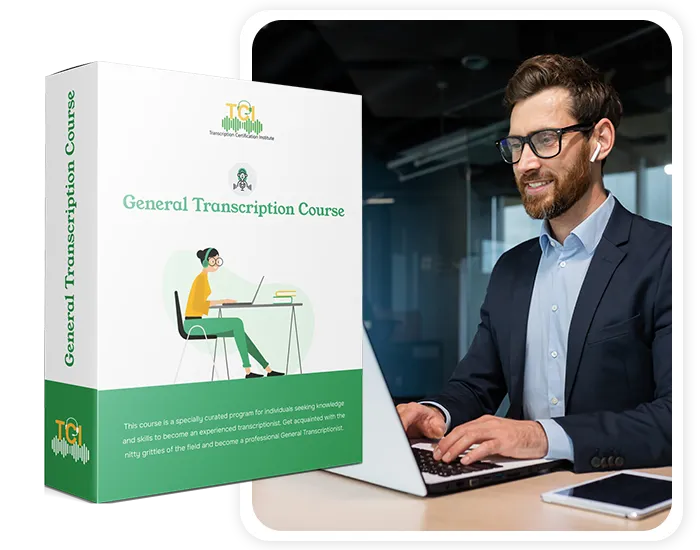
Our General Transcription Certification Online program equips you with the skills, tools, and confidence to build a rewarding transcription career from home.
This online transcription course has been developed by industry experts to reflect real-world transcription practices and prepare you for real client work.
You’ll learn to transcribe diverse audio and video files, handle multiple-speaker formats, and develop the level of accuracy employers expect from professional transcriptionists.
Beyond core transcription skills, the program also focuses on proofreading and formatting AI-generated transcripts to meet industry standards—an essential skill as automated transcription becomes more common across many sectors. You’ll also learn how to use modern AI tools responsibly and apply strong proofreading and quality-control practices to improve speed, accuracy, and overall productivity.
By the end of this transcriptionist certification course, you will:


This self-paced online transcription certification program typically takes 3–5 weeks to complete, depending on your schedule.

Access all materials anytime, from anywhere — on desktop, tablet, or mobile.
Average base salary
Our online transcription course covers all the essential topics you’ll need to become a confident, accurate, and efficient transcriptionist. Here's a sneak peek at some of the topics you'll explore:
We offer two flexible pricing options to fit your budget:

Save money upfront and start learning immediately.

For the US and Canada only.
100% Refund Guarantee
Why choose just one when you can enhance your transcription skills with our specially curated combo options? Get more value, expand your career opportunities, and save on costs by enrolling in our bundled courses.
$897
$750
Save $147
$299 x 3
Months
Duration: 7 - 9 weeks
$1,140
$999
Save $141
$380 x 3
Months
Duration: 9 - 11 weeks
$1,650
$1,499
Save $151
$550 x 3
Months
Duration: 10 - 12 weeks
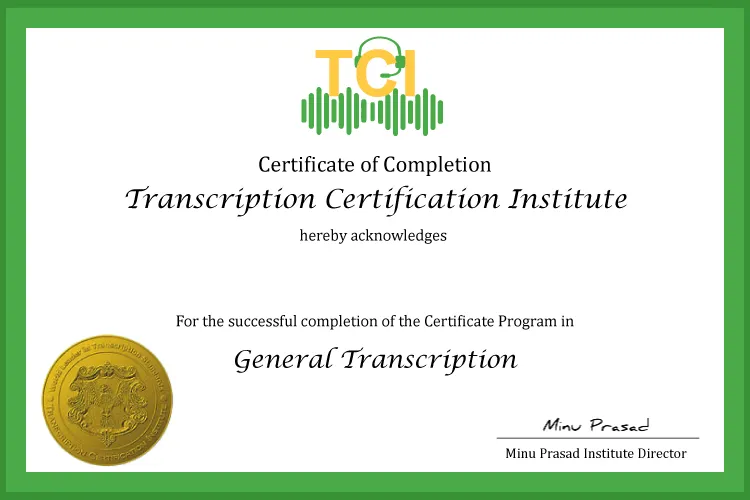
You can enroll in TCI's General Transcription Certification Program, complete the curriculum, and receive a certificate after completion.
The duration varies because of the flexible learning approach. However, we recommend that you complete the course in NO LESS than 21 days and a maximum of 90 days.
Our course fee is $499. You can pay in full or split your payment into three monthly installments of $199.
You can enroll by visiting TCI's official website, clicking "Enroll Now," following the provided instructions or contacting us for guidance on enrollment.
You must have a reliable computer or laptop with high-speed internet access. For the final exam, you must also have Microsoft Word 2010 or newer, and headphones that connect to your computer.
Yes, we provide practice tests to improve your skills and knowledge. You can access up to 3 practice tests for free.
To become a transcriptionist, you must have a strong command of the English language.
Yes, TCI's General Transcription Course is available internationally. However, if you live outside of the United States & Canada, you must pass an English test before enrolling in the course.